Florida Flu Season: Peak Months and Prevention
When Is Respiratory Season in Florida?
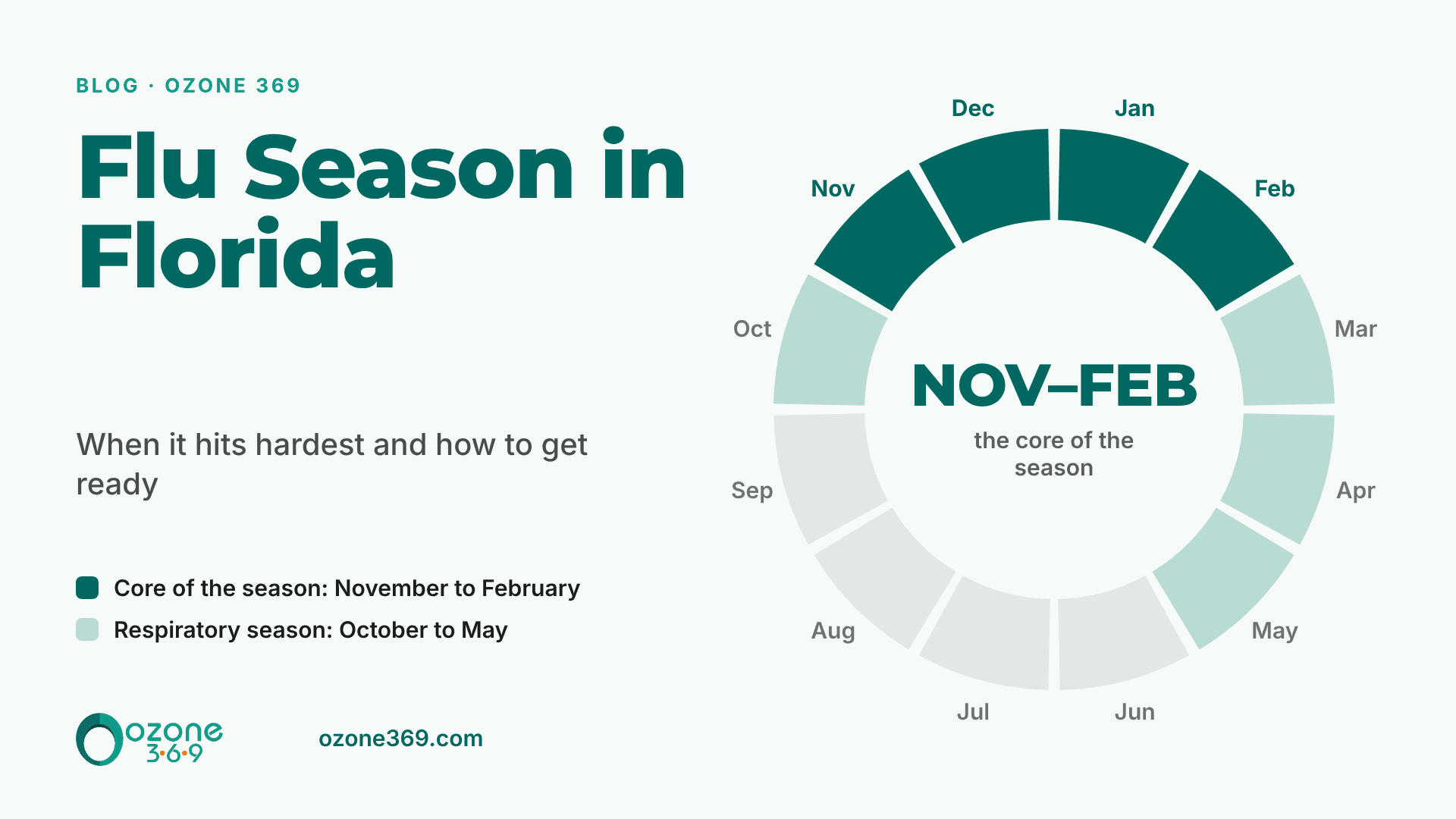
The Florida Department of Health runs intensive influenza surveillance from October through May, and the CDC defines the fall and winter respiratory season as the period from October to May. Within that range, the core of the season is November through February:
- Influenza: according to the CDC, it usually peaks between December and February, although the exact timing changes every year.
- In Florida, the pattern repeats with nuances. In the 2016-17 season, elevated activity stretched from late December to mid-April, with the statewide peak in February. In the south of the state (Palm Beach, Broward, Miami-Dade and Monroe), the peak came in late December, almost two months earlier than in the rest of the state. In 2017-18, the peak came in the week ending February 3, with higher activity than in previous seasons.
- RSV (respiratory syncytial virus) starts earlier in Florida. A CDC analysis of the 2014 to 2017 seasons found that in Florida it begins around mid-September and peaks in mid-December, while nationally the peak comes in early February. It also lasts about three weeks longer. And this year it is already showing: in the week of October 18 to 24, 2026, the Department of Health reported more children under 5 seen and hospitalized for RSV than in the previous three weeks.
- COVID-19: with three viruses circulating at once, the exact timing of each peak is hard to predict, and between December and January they may overlap.
What the CDC projects for 2026-27: a season similar to the last one, with combined peak hospitalizations for COVID-19, influenza and RSV within 20% of the 2025-26 peak.
How Did Last Season Look Nationally?
For reference: the CDC classified the 2025-26 season as moderately severe. Through January 3, 2026 alone, it estimated at least 15 million illnesses, 180,000 hospitalizations and 7,400 deaths from influenza in the United States, with influenza A(H3N2) subclade K as the main driver.
Why Do Infections Rise at This Time of Year?
Science has several pieces of the puzzle:
- Climate and humidity. Studies show that the influenza virus spreads and survives better when the air is cold and dry, and the dry air inside homes in winter also helps (Lowen and Steel, 2014). In subtropical regions like ours, the pattern is more varied: a global study of 78 locations found epidemics associated with both "cold and dry" and "warm and rainy" conditions (Tamerius et al., 2013).
- Contact during the rainy season. One review suggests that the humidity of tropical rains may favor transmission through surfaces (Paynter, 2015), which helps explain why in Florida RSV and the flu do not wait for the classic winter.
- More time indoors and more gatherings. Holidays, trips and family get-togethers between November and January bring more people together in enclosed spaces. It is a common-sense factor that matches the calendar of the peaks.
How to Get Ready Starting Now
The ideal approach is to combine several layers:
- Vaccination: the CDC recommends the annual flu vaccine for everyone 6 months and older, and there are options for RSV and COVID-19 depending on your age and condition. Talk to your doctor.
- Basic habits: wash your hands, ventilate indoor spaces, stay home if you are sick and seek care early if symptoms get worse.
- Support your defenses with the Inmune Booster. At Ozone 369, which focuses on biological medicine and ozone therapy (a tool that the scientific literature describes as an immune system modulator: Díaz Luis et al., 2013; Schwartz and Martínez-Sánchez, 2012), Dr. Carmen offers the Inmune Booster. It is a protocol that combines 3 autovaccines (major autohemotherapy) with 1 intravenous immune activator, designed to help you:
- strengthen your natural immunity,
- improve resistance to infections,
- reduce inflammation and oxidative stress,
- support recovery during periods of stress or illness.
It is recommended for people who want to stay strong during seasonal changes, before or after trips, or after periods of fatigue or illness. That is why it fits whether you want to arrive prepared for the peak of the season or the flu has already caught up with you and you want to support your recovery. And right now the Inmune Booster comes with a 25% discount.
The Best Time to Start Is Before the Peak
With the season already getting under way and the peak expected between December and February, getting ready today gives you an advantage. Write to us and Dr. Carmen will guide you on when and how to start your Inmune Booster.
This content is for informational purposes only and does not replace a medical consultation. Talk to a healthcare professional before starting any treatment.
Sources
Consulted on November 13 and 16, 2026.
- Centers for Disease Control and Prevention (CDC). 2026-2027 Respiratory Disease Season Outlook. cdc.gov
- CDC. Weekly US Influenza Surveillance Report: Key Updates for Week 53, ending January 3, 2026. cdc.gov
- Rose EB, Wheatley A, Langley G, Gerber S, Haynes A. Respiratory Syncytial Virus Seasonality — United States, 2014–2017. MMWR Morb Mortal Wkly Rep 2018;67(2):71–76. cdc.gov
- Florida Department of Health. Florida Flu Review, 2016-17 season (Section 6, Influenza and ILI surveillance). floridahealth.gov
- Florida Department of Health. Florida Flu Review 2017-18, Week 11. floridahealth.gov
- Florida Department of Health. Florida RSV Review, Week 42 (October 18–24, 2026). floridahealth.gov
- Lowen AC, Steel J. Roles of humidity and temperature in shaping influenza seasonality. J Virol 2014;88(14):7692–7695. pmc.ncbi.nlm.nih.gov
- Tamerius JD, Shaman J, Alonso WJ, et al. Environmental predictors of seasonal influenza epidemics across temperate and tropical climates. PLoS Pathog 2013;9(3):e1003194. pmc.ncbi.nlm.nih.gov
- Paynter S. Humidity and respiratory virus transmission in tropical and temperate settings. Epidemiol Infect 2015;143(6):1110–1118. pmc.ncbi.nlm.nih.gov
- Díaz Luis J, Macías Abraham C, Menéndez Cepero S. Efecto modulador de la ozonoterapia sobre la actividad del sistema inmune (Modulating effect of ozone therapy on immune system activity). Rev Cubana Hematol Inmunol Hemoter 2013. medigraphic.com
- Schwartz A, Martínez-Sánchez G. La ozonoterapia y su fundamentación científica (Ozone therapy and its scientific basis). Rev Esp Ozonoterapia 2012;2(1):163–198. dialnet.unirioja.es
Need Personal Guidance?
Our medical specialists are ready to analyze your biomarkers and guide you towards optimal health.