Epigenetics and Cancer Prevention: Beyond Our Genes
Are We Victims of Our Genetic Inheritance?
For decades, we have believed that our genes determine our biological destiny. If we inherit a genetic predisposition to certain diseases, does that mean we will inevitably develop them?
This was one of the central questions of my lecture, “Epigenetics and Cancer Prevention,” presented on October 28, 2026, during the Women Inspire Experience event at Miami Dade College.
The answer leads us to one of the most fascinating discoveries in modern biology: epigenetics.
The Human Genome Project: A Turning Point in Science
In 2001, the publication of the first results of the Human Genome Project transformed our understanding of genetics.
Until then, scientists estimated that humans might have more than 100,000 genes. However, we discovered that our genome contains approximately 20,000 protein-coding genes, and that only about 1.5% of our DNA consists of protein-coding sequences.
The rest of the genome, long referred to as junk DNA, includes numerous regions involved in regulating gene activity.
This discovery helped open a new perspective: it is not enough to know which genes we have; we must understand how, when, and why they are expressed.
What Is Epigenetics?
Epigenetics is the science that studies the mechanisms regulating gene activity without changing the underlying DNA sequence.
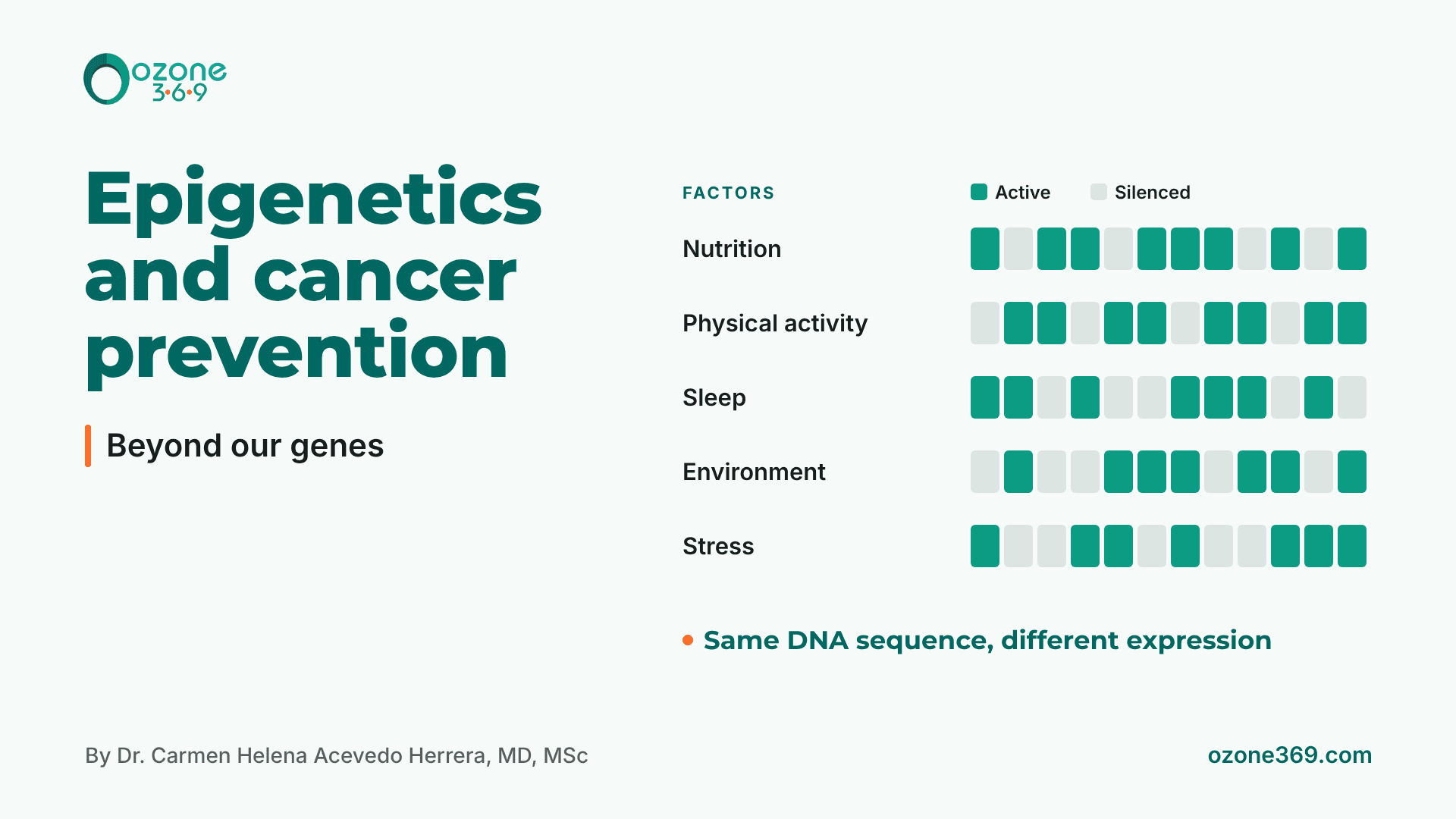
Imagine our genes as a book of instructions. Epigenetics helps determine which instructions are used, which remain silent, and when they become active.
These mechanisms respond to biological and environmental signals, and some can change throughout our lives.
Nutrition, physical activity, sleep, environmental exposures, and certain stress-related processes can influence our biology and epigenetic regulatory mechanisms.
Our genes are not our inevitable destiny. Our genetic inheritance constantly interacts with the environment in which we live.
The Four Levels of Being: An Integrative Perspective
During my lecture, I also shared the vision underlying the Ozone 369® Methodology, through which we understand the human being as existing across four deeply interconnected levels:
- Body: our biology, metabolism, immune system, and physical manifestations.
- Mind: our conscious and unconscious thoughts, whose interactions with the nervous, endocrine, and immune systems are studied through psychoneuroimmunology.
- Soul: our emotional dimension, experiences, and internal conflicts, which can influence physiological responses.
- Spirit: our energetic body, understood from an integrative and spiritual perspective as a dimension of connection and harmony with our environment.
This model invites us to recognize that health cannot be reduced to a laboratory result or a medical diagnosis. Scientific evidence regarding epigenetic regulation is stronger for certain biological, environmental, and psychosocial factors, while the energetic dimension is gaining increasing attention within broader interpretations of advances in quantum physics.
Epigenetics and Cancer: The Importance of Prevention
Cancer does not develop overnight. It is the result of a complex, multifactorial process involving genetic and epigenetic alterations, as well as cellular regulatory mechanisms that may evolve over many years.
We know that epigenetic alterations contribute to the development of different types of cancer and that certain environmental and lifestyle factors can modify our risk. Therefore, prevention begins with identifying modifiable risk factors early and taking action.
Healthy nutrition, regular physical activity, reducing exposure to carcinogens, and other evidence-based preventive measures can help lower the risk of certain cancers. Mental and emotional well-being are also important components of comprehensive healthcare.
Epigenetics opens new opportunities to investigate how these factors interact with our biology and to develop personalized medicine strategies.
From Knowledge to Action: Epigenetic Mapping and the 90-Day Reset Program
Within the Ozone 369® Methodology, we incorporate a personalized wellness assessment through two complementary tools:
Epigenetic Mapping Test
At Ozone 369®, we use Cell Wellbeing's S-Drive technology, a wellness assessment system based on a sample of four hair strands collected with their root bulbs.
Using a bioresonance-based reading device, information captured from the hair sample is digitized and processed through specialized algorithms in Germany.
The result is a personalized wellness map that explores nutritional, metabolic, and environmental indicators, including vitamins, minerals, antioxidants, amino acids, and potential environmental stress factors.
90-Day Epigenetic Reset Program
Based on the epigenetic mapping results, we develop a personalized plan that integrates nutrition, lifestyle modifications, and the therapeutic tools of the Ozone 369® Methodology.
Depending on individual needs and medical evaluation, the program may incorporate ozone therapy, orthomolecular medicine through intravenous nutrient therapies, detoxification protocols and heavy metal chelation when clinically indicated, and oral supplementation with Ozone 369® formulations.
The goal is to support the body's natural regulatory mechanisms, address identified imbalances, and promote sustainable changes that contribute to overall health and well-being.
These wellness tools are not equivalent to clinically validated genetic or epigenetic tests for detecting or predicting cancer, nor do they replace recommended cancer prevention and early detection programs.
Prevention Begins with Knowledge
The most important message of epigenetics is that our genetic inheritance does not tell our entire story.
Although we cannot control every factor that determines our health, we can take action on many of them.
Because our genes are part of our story, but they do not completely determine our future.
Prevention begins with knowledge and the choices we make every day.
Dr. Carmen Helena Acevedo Herrera, MD, MSc Creator & Scientific Director, Ozone 369® Methodology Founder & Director, Munay Integrative Health
This content is for informational purposes only and does not replace a medical consultation. Talk to a healthcare professional before starting any treatment.
Sources
Article based on the lecture “Epigenetics and Cancer Prevention” by Dr. Carmen Helena Acevedo Herrera, presented on October 28, 2026, at the Women Inspire Experience event (Miami Dade College). The text is the author's own.
Need Personal Guidance?
Our medical specialists are ready to analyze your biomarkers and guide you towards optimal health.